


More Spocky, Less Rocky – We Need Smarter Leaders
Updated: Sep 6, 2025
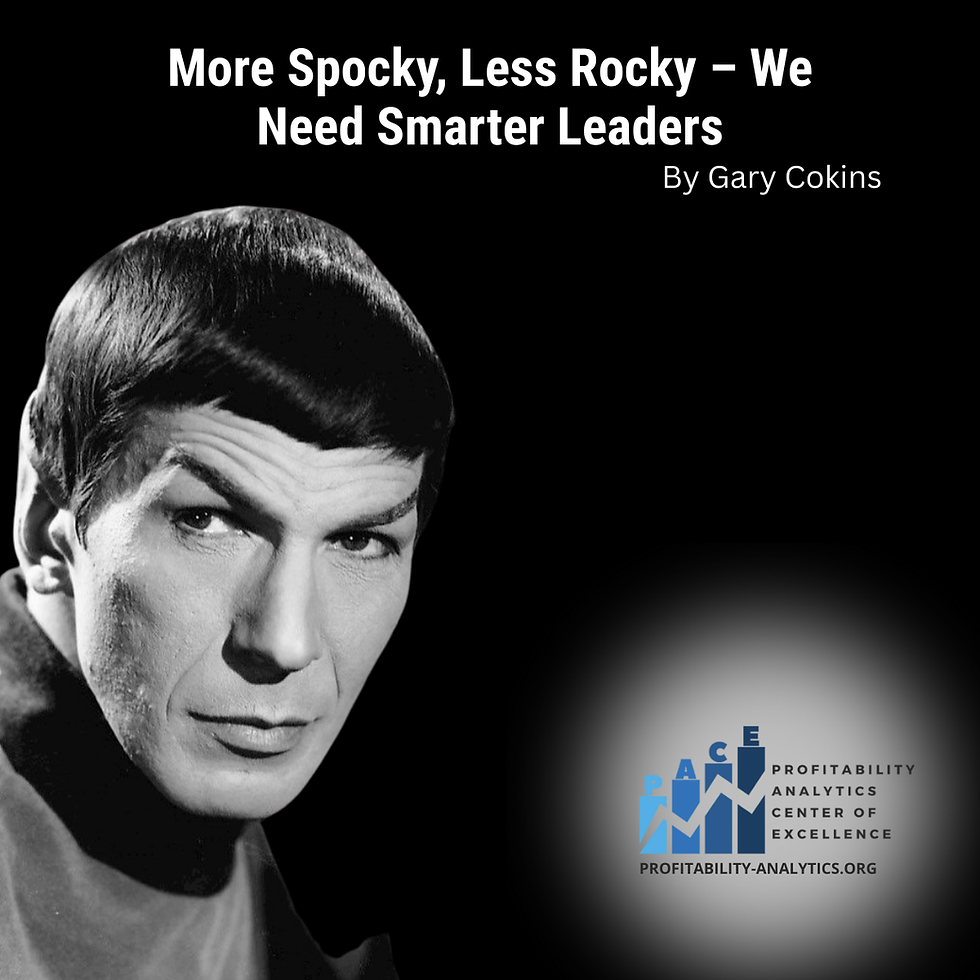
With the passing in 2015 of the actor Leonard Nimoy, who was the character Spock in the short three year late-1960s but never forgotten television series Star Trek series, let’s consider his character’s behavior in contrast to some executives you may have worked for.
As an introduction, on the shelves in the business section of any bookstore are numerous books about leadership and management. I have never considered myself to be a motivational writer or speaker who describes the importance of executives rallying the work force with inspiration. My interests are more with educating managers and employee teams to help their organizations improve their performance – to be better, faster, cheaper, and smarter. My authored articles and books are on enterprise and corporate performance management (EPM/CPM) methods that are included in the PACE Framework.
Now I am increasingly writing about the topic of leadership because in my career I have seen examples of leadership styles that reflect individual desire for power more than a duty to improving organizational performance.
Muscle or brain? Strength or smarts? Command or guidance? I choose the latter in all three cases. But how are these relevant to aligning managers’ and employee team’s behavior, projects, and priorities with the executive team’s strategic objectives to actually execute the executives’ usually well-formulated strategy?
Analytics-based enterprise and corporate performance management (EPM/CPM)
The primary source for improvements in organizational effectiveness and decision making is shifting toward the use of analytics of all flavors. Traditional approaches – like the 1980’s management by objectives (MBOs), bullying employees, and hollow wall banners of rhetoric (“Quality Comes First”) – are being superseded by deploying and integrating business analytics into accepted enterprise and corporate performance management (EPM/CPM) methods. Examples of business analytics are correlation analysis to understand causal relationships, regression analysis for forecasting, and segmentation to different types of customers. Examples of EPM/CPM methods are the balanced scorecard with its key performance indicators (KPIs), driver-based rolling financial forecasts, enterprise risk management (ERM), lean management, capacity management, and customer profitability reporting and analysis.
Applying business analytics from the CEO’s office to each employee’s desktop enables an organization to frame and solve complex business problems, manage performance to achieve measurable objectives with KPI targets, drive sustainable growth through innovation, and anticipate and manage change.
Having a foundation for business analytics is important. My personal bias of converting insights and foresight into actions often makes me forget that many organizations have issues with data quality and with disparate and nonstandard data sources. Organizations will continue to have problems with all of their data – including Big Data – which they are collecting. Even if their source data has high integrity and is accessible, it still takes time and effort to run reports and provide them to the relevant people. It also takes additional time for those people to leverage the relevant information assuming the right systems are in place. Data integration and management – plus techniques like extract, transform and load (ETL) – can be prerequisites for analytics-based EPM/CPM.
The emergence of predictive analytics
One particularly powerful flavor of analytics is predictive analytics. Applying predictive analytics results in making proactive, forward-looking decisions that go beyond simple query-and-reporting data mining questions like “What happened?”, “How many?” and "How often?” to answer high-impact questions like “Why did it happen?”, “What will happen next?” and “What is the best that can happen?”
A survey by the consulting firm Accenture reported that most companies are far from where they want and need to be when it comes to implementing analytics. They are still relying on intuition and gut feeling, rather than fact-based data, when making decisions. What is needed today is the seamless integration of the EPM/CPM managerial methods that I earlier mentioned. Each method can and should be embedded with business analytics, especially predictive analytics.
Overcoming natural resistance to change
Now let’s get to the Star Trek Spock character. What major barrier continues to obstruct the adoption rate of EPM/CPM methods? Technology is no longer an impediment because software solutions are now proven. The barriers are social, behavioral and cultural. There are many examples of this obstacle, including people’s natural resistance to change; not wanting to be measured or held accountable; fear of knowing the truth (or others knowing the truth); reluctance to share data or information; and the excuse “we don’t do that here.”
The reality is few of us, if any, have training or experience as organizational change management specialists. We are not sociologists. We are not psychologists. And neither are many executives in leadership positions. However, we are learning to become change management practitioners.
I credit the New York Times op-ed columnist Maureen Dowd for my title. Her column “Less Rocky, More Spocky” described politicians. But when I apply this title to mission-directed organizations, perhaps like yours, I reverse swap the sequence of the two names. I would prefer to have an organization’s leaders exhibit and promote having Star Trek’s Spock-like logic and analytical skills than leaders like Rocky Balboa, punching meat carcasses in the freezer. Captain James T. Kirk, who was played by William Shattner, needed Spock on the deck of the starship Enterprise. We all do too.
Leaders need to not only set the strategic direction and answer this question for their employee: “Where do we want to go?” They then need their organization to “get there” including with EPM /CPM methods. Leader need their managers and employee teams to follow them. Sadly, leaders without followers are just taking a walk in a park.


During my five plus decades working in “the real world” I’ve seen just about all of the behaviors Gary has discussed. C-level executives – as well as other managers – have spent years learning how to “play the game.” Although they often implement new methodologies, they seldom learn how to use them effectively. Instead, they will use them to support their existing ideas and beliefs and ignore them when the results suggest they are wrong. They are also often much more concerned with their own short-term success than their organization’s long-term success. Until executives are incentivized to take the long view, we’ll continue to struggle to have organizations reap the benefits that can be realized by effectively using today’s more…
Well said. Although, I do find the role of the leader is to set a vision and motivate employees to that vision. However, I often find "leaders" are few and even fewer are good at articulating vision, especially vision informed by data. I do see a lot of managers in leadership roles chasing fads and following conventional wisdom as opposed to data driven insights.