


The Agile Enterprise: Navigating Volatility Through Driver-Based Planning

The Hundred-Day Blind Spot
It was late October, and Mark Ryan, General Manager of GlobalTech, sat in his office staring at a consolidated financial report that was exactly 104 days out of date. Outside his window, the market was shifting at an unprecedented pace. Inside his rapidly expanding technology enterprise, time seemed to stand still.
GlobalTech was a victim of its own success. For three years, the company had ridden a wave of strong market demand, expanding its product lines and capturing significant market share. But the economic environment had recently grown hostile and unpredictable. Volatility was no longer an exception; it was the new normal.

The crisis that brought them to this breaking point had begun with a sudden geopolitical shift, triggering an immediate 15% tariff increase on critical electronic components and simultaneously choking the global supply chain.
The morning the news broke, Mark had called an emergency meeting and asked his executive team a straightforward question: "How does this impact our fourth-quarter margins, and do we need to adjust our pricing or production schedules today?"
The answer, to his deep frustration, was silence.
To find that answer, Janis Novak, GlobalTech's Controller, and her Financial Planning and Analysis (FP&A) team had to embark on a gruelling, manual process. They spent weeks chasing down disparate Excel spreadsheets from various department heads.
The delay was not due to a lack of effort; they were fighting a losing battle against the company's own internal complexity. GlobalTech's data was trapped in departmental silos:
Sales spoke in conversion rates and managed revenue forecasts in highly optimistic, custom-built spreadsheets.
Manufacturing spoke in machine utilization and tracked capacity constraints in a completely different legacy system.
Purchasing had to deal with daily price fluctuations that never made it into the official financial models.

Finance was left to translate it all into dollars, a process that took weeks. Janis's team spent 80% of their time just gathering and cleaning data, attempting to reconcile massive departmental variances. Sales assumed production could seamlessly absorb the cost hikes; production assumed sales would raise prices without losing volume.
When Janis finally placed the consolidated impact report on the conference room table, 104 days after the initial shock, the room was silent. The report was a masterpiece of financial accuracy. It detailed exactly how the tariffs had eroded their margins, how the delayed pricing adjustments had cost them millions in potential revenue, and how production bottlenecks had led to expensive, expedited shipping fees.
Jack Baxter, the Corporate President, flipped through the pages, closed the folder, and looked up.
"This report is flawless. It tells me exactly how much money we lost three months ago. But it tells me absolutely nothing about what we should do tomorrow."
The statement hung in the air, exposing a fundamental flaw in GlobalTech's DNA. Despite its cutting-edge products, the organization was managing its future by looking firmly in the rearview mirror.
GlobalTech relied on static, bottom-up budgets that took 4 months to build and became obsolete the moment they were published. When the market shifted, the budget could not keep pace.
The executive leadership team found itself constantly reacting to disruptions, absorbing financial blows, and scrambling to recover, rather than anticipating changes and pivoting strategically.
For Mark Ryan, the hundred-day blind spot was a wake-up call. It was clear that traditional financial planning was no longer sufficient. The finance department was functioning merely as a historical scorekeeper - a task-based reporting unit bogged down by administrative heavy lifting.

If GlobalTech was going to survive in an increasingly volatile market, it could no longer afford to wait a hundred days to understand the financial impact of a business disruption. The company needed a radical transformation. It needed to cut response times from months to minutes and elevate the finance function from a back-office reporting team to a proactive, strategic business partner.
Diagnosing the Disconnect
The fallout from the hundred-day delay left GlobalTech's leadership with a stark realization: working harder was no longer a viable strategy. The system itself was broken.
Determined to uncover the root causes of their forecasting paralysis, Mark Ryan commissioned a comprehensive internal assessment, bringing in Ross Peterson, a seasoned management consultant known for untangling complex corporate dysfunctions.
Ross spent three weeks embedded within GlobalTech, shadowing the FP&A team and mapping the flow of information from the factory floor to the boardroom. When he presented his findings, the diagnosis was sobering. GlobalTech did not have a people problem; it had a severe, systemic disconnect.
The investigation revealed a deeply siloed corporate structure where operational managers and financial controllers were essentially speaking different languages:
Sales spoke in conversion rates and pipeline volume.
Manufacturing spoke in terms of machine utilization and unit costs.
Marketing spoke in terms of campaign leads and customer acquisition.
Finance was left to translate it all into dollars - a process that took weeks. Because there was no shared framework, the burden of translation fell entirely on Janis Novak's team, who were trapped in a labyrinth of historically grown, unstandardized Excel models.

Ross highlighted three critical failures in his presentation to the executive board:
Manual Consolidation: The finance team was spending nearly 90% of their time manually extracting and reconciling data from disconnected legacy systems, leaving virtually no capacity for strategic guidance.
The Translation Gap: Operational metrics did not translate directly into the general ledger accounts that Finance was required to forecast.
Operational Whiplash: Because Finance could not provide timely insights, operational leaders were forced to fly blind, making daily decisions without visibility into the financial consequences.
To illustrate this operational whiplash, Ross pointed to a recent, painful example. A month earlier, Justin Roberts had authorized a significant increase in marketing spend to capitalize on a competitor's misstep. The campaign was a massive success, driving a sudden spike in demand.
However, because Jim Simpson in Manufacturing had no real-time visibility into this marketing initiative, the factory was caught completely off guard. To meet the sudden demand, Jim had to authorize overtime and expedite the shipment of raw materials.
Justin celebrated the revenue spike, while Jim was penalized for cost overruns. Meanwhile, it took Finance six weeks to calculate the devastating truth: the combined cost of the marketing spend and the manufacturing overtime had completely wiped out the profit margin on the new sales.
"You are trying to run a dynamic, fast-paced technology company using traditional, accounting-centric planning," Ross concluded. "You are forecasting based on historical financial outcomes rather than the operational activities that actually drive those outcomes."
The assessment made it undeniably clear. The static, bottom-up budgeting process was actively harming the company's profitability. If GlobalTech wanted to regain its agility, minor process tweaks would not suffice. They had to stop planning around accounting line items and start planning around the proper drivers of their business.
The Driver-Based Paradigm
The diagnosis was precise, but the cure required a fundamental rewiring of GlobalTech's corporate DNA. Mark Ryan knew that simply demanding faster reports from Finance would only lead to burnout. To bridge the chasm between operations and Finance, they needed a common language.
Ross Peterson returned to the executive boardroom not with a new software proposal but with a conceptual shift. He introduced the leadership team to the driver-based planning methodology.
"For years, you've been trying to forecast the scoreboard," Ross explained to the skeptical department heads. "You look at last year's revenue, add five per cent, and call it a budget. But revenue isn't something you can directly control. It's an outcome."
To facilitate this shift, Ross organized an intensive, cross-functional workshop. The goal was to construct a "Value Driver Tree" - a comprehensive map of the complex cause-and-effect relationships across the enterprise.
Finance and operational leaders, previously siloed by their distinct metrics, were forced to the whiteboard to partner closely. The tension in the room was palpable as they began with the overarching strategic targets: revenue growth and operating margin. Ross challenged them to break those high-level goals into granular, operational inputs.
"It's simple." Sam Wente from Sales asserted, crossing his arms. "Revenue is the number of units we sell multiplied by the price."
"That's the math," Ross countered gently. "But what drives the number of units you sell?"

Through guided exercises, the team began to peel back the layers of their own operations, mapping the logic live on the board:
Level 4 (The Input): Justin Roberts noted that Marketing Spend directly impacted lead generation.
Level 3 (The Volume): The number of Qualified Leads entered the sales pipeline.
Level 2 (The Execution): Sam Wente acknowledged that the Sales Conversion Rate dictated how many leads became paying customers.
Level 1 (The Constraint): Jim Simpson added that Production Capacity and machine utilization determined whether they could actually fulfil those orders on time.
For the first time, the interconnectedness of GlobalTech's operations was laid bare. If Marketing increased its spend to drive more leads, the value tree immediately illustrated the cascading impact: Sales would need a higher conversion rate to justify the cost, and Manufacturing would need sufficient capacity to avoid expensive overtime.
The breakthrough came when Janis Novak, the Controller, realized the power of this new paradigm.
"If we know the mathematical relationship between these operational drivers and our financial outcomes," she said, her eyes widening, "we don't need to wait for the books to close to know where we stand. If Sam's conversion rates drop by two per cent, we can instantly calculate the impact on our bottom line."
However, mapping the logic was only half the battle. The value tree was useless if it lived only on whiteboards and in isolated Excel files. GlobalTech took the decisive step of embedding these mathematical business rules into a centralized Enterprise Performance Management (EPM) system.

This platform-agnostic integration automated the data flow, pulling real-time operational metrics - like daily lead conversions from the CRM and machine uptime from the factory floor - directly into the financial models. It established a single source of truth. When Sam looked at his sales forecast, he was looking at the same data Janis was using to project cash flow. Anticipating cultural resistance from middle managers accustomed to padding historical budgets, Mark Ryan launched a targeted pilot program in the Marketing department.
The pilot was a resounding success. Within weeks, Justin Roberts used the driver-based model to demonstrate precisely how a recent shift in digital advertising spend had increased lead quality, mathematically justifying his budget request. He didn't just ask for more money; he proved the return on investment using the company's new, shared language.
When other department heads saw Marketing securing resources based on transparent, data-driven logic, the resistance crumbled. The value tree was no longer viewed as a financial policing tool, but as a powerful mechanism for operational leaders to optimize their impact on the company's bottom line.
The Connected Enterprise
Six months after the initial workshops, the atmosphere in GlobalTech's executive boardroom was unrecognizable. The tension and defensive posturing that had characterized their meetings during the tariff crisis were gone. In their place was a focused, collaborative energy. The value driver tree was fully integrated into their Enterprise Performance Management system, resulting in transformative outcomes.
The most profound shift occurred within Janis Novak's FP&A team. For years, they had been the company's data janitors. With the automated framework pulling real-time operational data directly into the financial models, that burden evaporated. Her analysts were no longer just reporting the news; they were helping to write it.

The true test of this new capability arrived unexpectedly on a Thursday afternoon. A major port strike on the West Coast threatened to delay a critical shipment of microprocessors severely - the key component for GlobalTech's highest-margin product line, the Pro Series.
In the past, this news would have triggered another hundred-day blind spot. Mark Ryan would have asked for the financial impact, and Janis would have embarked on a month-long quest to reconcile conflicting departmental assumptions while the company bled cash.
This time, the response was immediate. Mark convened the executive team. But instead of empty spreadsheets, Janis projected the company's live value driver tree onto the screen, directly connected to its current operational realities. Mark convened the executive team. But instead of empty spreadsheets, Janis projected the company’s live value driver tree onto the screen, connected directly to their current operational realities.
"Jim," Janis asked the Manufacturing Director, "if this shipment is delayed by three weeks, what happens to our production capacity for the Pro Series?"
Jim didn't need to guess; he checked his dashboard. "We'll have to idle line three for ten days. That drops our overall utilization rate by eight percent and spikes our unit cost on the remaining inventory." Janis turned to Sam Wente in Sales.
"Sam, if we can't fulfill Pro Series orders for a month, what's the impact on your conversion rates and pipeline?"
"We'll lose at least 15% of our current late-stage pipeline to competitors who have local inventory," Sam replied grimly. "And we'll have to offer discounts to hold onto the rest."
Janis didn't need to build a new spreadsheet. She adjusted the drivers in the EPM system: lowering production capacity by 8%, decreasing the sales conversion driver by 15%, and factoring in the anticipated discount rate.
Within minutes, the system recalculated the entire financial forecast. The executive team watched as the projected fourth-quarter revenue dropped and the operating margin compressed. But they didn't just see the problem - they saw the levers they could pull to fix it.
"Okay," Mark said, studying the real-time simulation. "We know the hit. Now, how do we mitigate it? Justin, if we shift our marketing spend entirely away from the Pro Series and double down on the standard line - which we have in stock - can we offset the revenue loss?"
Justin adjusted the model's marketing spend drivers, increasing the projected lead volume for the standard line. Sam adjusted his conversion rates based on the new leads. Jim confirmed they had the capacity to handle the increased volume.
The model recalculated again. The new scenario showed that while top-line revenue would still take a slight hit, the aggressive shift to the higher-margin standard line would actually protect their overall profitability.
The executive team no longer had to wait months for answers. They utilized the driver-based model to run instant, real-time simulations, making a critical strategic pivot in less than an hour.
GlobalTech had achieved unprecedented strategic agility. The cross-functional alignment was absolute; Sales, Manufacturing, Marketing, and Finance were all operating from a single source of truth. Their forecasting accuracy skyrocketed because it was rooted in operational reality, not historical accounting.

The hundred-day blind spot was a relic of the past. By embracing the driver-based paradigm, GlobalTech had elevated its finance department into a capability-enabled, value-generating partner. They were no longer reacting to the market; they were anticipating it, equipped to navigate volatility and sustain a definitive competitive advantage proactively.
The Blueprint for Strategic Agility
GlobalTech's journey from forecasting paralysis to strategic agility offers a compelling blueprint for modern enterprises. When General Manager Mark Ryan first confronted the "hundred-day blind spot," the company was a victim of its own outdated processes - attempting to manage a dynamic, fast-paced business through the rearview mirror of static, accounting-centric budgets.
By the end of their transformation, GlobalTech had not only accelerated its response times from months to minutes but had fundamentally rewired its corporate DNA.
The shift to driver-based planning was never merely an IT implementation. As the initial assessment revealed, the root of GlobalTech's problem was a severe disconnect between daily operations and financial outcomes. By building a comprehensive value driver tree, the company created a common language.
Sales, Manufacturing, Marketing, and Finance were no longer fighting over arbitrary budget lines or defending historical spend; they were collaborating to optimize the operational levers that mathematically dictated their success.
For business leaders seeking to navigate an increasingly volatile economic environment, the GlobalTech case study offers four critical takeaways:
1. Forecast the Drivers, Not the Outcomes
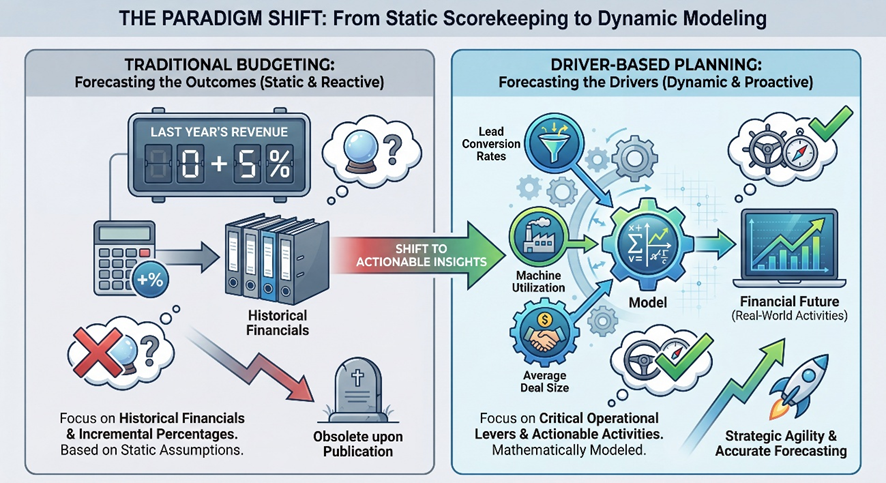
Traditional budgeting attempts to predict the scoreboard by adding incremental percentages to historical financials. Driver-based planning focuses on the plays that win the game. By identifying the critical few operational levers - such as lead conversion rates, machine utilization, or average deal size - companies can mathematically model their financial future based on actionable, real-world activities rather than static assumptions.
2. Dismantle Silos with a Single Source of Truth
Volatility severely punishes fragmented organizations. When departments operate with conflicting metrics and isolated spreadsheets, decision-making stalls, and the burden of translation falls heavily on the finance team. Embedding mathematical business rules into a centralized Enterprise Performance Management (EPM) system ensures that when the market shifts, the entire executive team is looking at the exact same data.

3. From Scorekeeper to Strategist
As long as a Financial Planning and Analysis (FP&A) team is consumed by manual data consolidation and error-checking, they cannot provide strategic value. Automating the flow of operational data into financial models frees finance professionals from administrative heavy lifting. This capacity shift allows them to focus on high-value scenario analysis, benchmarking, and guiding the executive team through complex, real-time decisions.

4. Prioritize Agility Over Static Precision
In a disruptive environment, a budget that takes four months to build is obsolete the moment it is published. The goal of modern financial planning is not to create a perfect, unchangeable document. Instead, it is to build a dynamic, living model that allows leaders to run instant "what-if" simulations. When supply chains break or competitors pivot, the ability to immediately ascertain the impact on margins and cash flow is a profound competitive advantage.

In today's economic landscape, disruption is not an anomaly; it is a constant. Companies that rely on traditional, siloed planning will continue to find themselves reacting too late to market shocks.
GlobalTech's story demonstrates that by embracing the driver-based paradigm - aligning people, processes, and tools around the true engines of value - organizations can do more than survive volatility. They can harness it to sustain a definitive, proactive edge.
Appendix I
The Driver-Based Dictionary
Driver-Based Planning: A financial methodology that links business activities to financial outcomes by forecasting the key operational metrics (drivers) that mathematically dictate performance, rather than extrapolating historical accounting data.
Value Driver Tree: A visual and mathematical hierarchical model mapping the cause-and-effect relationships between high-level strategic goals (e.g., revenue, margin) and granular, operational inputs.
Business Driver: A specific, measurable operational activity or external factor that has a direct, material impact on financial performance (e.g., sales conversion rate, machine utilization, raw material cost).
Enterprise Performance Management (EPM): A centralized suite of software applications designed to help organizations plan, budget, forecast, and report, serving as the single source of truth for driver-based models.
Bottom-Up Budgeting: A traditional, often static approach where individual departments create detailed, line-item budgets based on historical spend, which are then aggregated company-wide.
Scenario Analysis: The process of evaluating the potential impact of future events by adjusting variables (drivers) within a financial model to instantly see how they affect outcomes like revenue or cash flow.
Operational Levers: The internal activities or metrics that management can directly control to improve business performance (e.g., marketing spend, headcount, production schedules).

The Executive Playbook: A 9-Month Roadmap to Strategic Agility
Transitioning an organization from traditional, accounting-centric budgeting to dynamic, driver-based planning is a fundamental business transformation. It requires dismantling deeply ingrained silos and rewiring how the company measures success.
For CEOs and CFOs, success depends on balancing three critical pillars: People, Processes, and Technologies. The following roadmap provides a strategic blueprint for eliminating the "hundred-day blind spot."
Part I: The Implementation Timeline
A successful rollout should be phased to build momentum, demonstrate early value, and manage cultural resistance. A typical enterprise implementation spans six to nine months.
Phase 1: Strategic Alignment & Discovery (Months 1–2)
Objective: Diagnose forecasting bottlenecks and secure cross-functional executive buy-in.
Action: Conduct an internal assessment of current planning cycles. Identify where operational decisions disconnect from financial outcomes.
Milestone: Executive consensus on the need for change and the formation of a cross-functional steering committee.
Phase 2: Architecting the Value Tree (Months 3–4)
Objective: Map the mathematical relationships between operational activities and financial results.
Action: Host collaborative workshops with Finance and operational leaders. Identify the "critical few" business drivers. Build the cascading value driver tree on paper before touching any software.
Milestone: A fully documented, enterprise-wide value driver tree approved by all department heads.
Phase 3: Targeted Pilot & Technology Integration (Months 5–6)
Objective: Prove the concept in a controlled environment and establish the technological foundation.
Action: Select a centralized EPM system. Automate data feeds from operational systems (ERP, CRM). Launch a pilot program in a single, data-rich department (e.g., Marketing) to demonstrate real-time scenario modeling.
Milestone: A successful pilot demonstrating measurable improvements in forecasting speed, creating internal champions.
Phase 4: Enterprise Rollout & Capability Shift (Months 7–9+)
Objective: Scale the methodology across the organization and elevate the FP&A function.
Action: Roll out the EPM system company-wide. Train operational managers to use the system for their own scenario planning. Officially transition FP&A capacity from data consolidation to strategic analysis.
Milestone: The first fully integrated, driver-based corporate planning cycle is executed, enabling instant "what-if" simulations at the executive level.

Part II: Best Practices by Pillar
1. People: Culture and Leadership
Mandate Top-Down Sponsorship: Driver-based planning cannot be delegated entirely to IT or Finance. The CEO and CFO must actively champion the initiative as a strategic business imperative.
Co-Create with Operations: Finance cannot build the value tree in isolation. If the Sales Director does not believe in the conversion rate metric used in the model, the entire system loses credibility.
Manage the Cultural Shift: Transparency can be threatening. Address resistance by celebrating early wins and demonstrating how the new system helps managers secure resources based on objective data, rather than negotiation.
2. Processes: Governance and Methodology
Focus on the "Critical Few": Do not attempt to boil the ocean. Focus on the 20% of operational drivers that dictate 80% of the financial outcomes. If a metric does not materially move the needle, leave it out of the executive model.
Standardize Data Definitions: Establish strict governance. If Marketing defines a "qualified lead" differently than Sales, the mathematical link breaks.
Embed Scenario Planning: Do not wait for a crisis. Make "what-if" scenario analysis a standard agenda item in monthly executive meetings to constantly test the organization's resilience.
3. Technologies: Systems and Data
Establish a Single Source of Truth: Eradicate the fragmented landscape of offline Excel spreadsheets. Implement a robust, platform-agnostic EPM system where all departments access the exact same data.
Automate Data Ingestion: A driver-based model is only as good as its inputs. Integrate the planning platform directly with source systems so the financial model updates automatically as operational realities change.
Prioritize Flexibility: The business environment will change. Choose technology that allows the FP&A team to easily add new drivers and build new scenarios without requiring a massive IT overhaul.


Comments