


Cutting Costs Without Losing the Soul: The Art of Expense Reduction with Cultural Intelligence

By Pedro San Martín, Principal at Asher PwC Interamericas

Executive Summary
Cost reduction initiatives fail not because of flawed financial models, but because of cultural blind spots. This whitepaper presents a framework for achieving sustainable overhead reductions of 10-30% by integrating cultural intelligence with financial precision. Based on three years of cross-regional implementations spanning Florida to the Philippines, we reveal why technically sound cost-cutting plans fracture in human interactions—and how to prevent it.
Key Finding: Organizations that incorporate cultural sensitivity mapping into their cost reduction strategies achieve 40% higher success rates in meeting targets while maintaining team engagement.
The Cost of Cutting Without Context
Over the past three years, I’ve partnered with CFOs across Florida, Central America, Colombia, Oslo, and the Philippines on cost-reduction initiatives. The plans were robust—EPM models and projections were precise and defensible. Yet, challenges persisted: silence in Manila meetings, tension in Bogotá boardrooms, and disconnects between teams in San Pedro Sula and Stavanger. The numbers worked, but the culture didn’t.
Achieving 10–30% reductions in global overhead demands more than technical precision. It requires cultural intelligence—a blend of financial mastery and human insight. This whitepaper outlines a new approach to cost control, ensuring cuts align with cultural values to drive sustainable results without eroding trust.
2. Why Do Perfect Plans Fail Across Global Teams?
Cost-cutting plans often shine in systems like Oracle EPM: tight targets, clear timelines, and optimized models. Yet, human dynamics can unravel them. In Oslo, a shared services rollout stalled due to unconsulted local teams. In the Philippines, centralized procurement met quiet resistance. As one CFO noted, “They nodded, but nothing changed.”
The issue isn’t the numbers—it’s the context. Financial leaders must anticipate how cuts affect local norms, hierarchies, and perceptions of control. Effective cost reduction pairs technical precision with cultural choreography.
Key Question: How will your plan land in Bogotá, Cebu, or Malmö? Numbers are universal; experiences are not.
3. The Hidden Costs of Ignoring Culture
Direct costs are easy to track, but cultural friction creates invisible losses:
Erosion of trust: Teams disengage when cuts feel imposed.
Passive resistance: Silence masks noncompliance, delaying execution.
Talent loss: High-value employees leave when morale drops.
Customer impact: In Central America, a 30% travel budget cut reduced customer renewals by undermining relationship-driven account managers.
PwC’s 2024 Pulse Survey found that 61% of finance leaders cite organizational alignment as the top barrier to transformation.
The equation is straightforward:
Hidden cost = Cultural friction × Scale of change × Leadership oversight
4. Balancing Efficiency and Cultural Sensitivity
Cultural intelligence doesn’t mean softening cuts—it means sequencing and surfacing:
Sequencing: Introduce reductions in ways that align with local pacing and priorities. In Bogotá, we shifted from individual metrics to team-based performance pods, aligning with cultural preferences for group cohesion. The result? Targets exceeded with minimal resistance.
Surfacing: Uncover how local expectations shape reactions to cuts. Engage teams early to address concerns before they fester.
This approach preserves savings while minimizing damage. The cut remains; the friction doesn’t.
5. A Practical Framework for Culturally Intelligent Cost Leadership
Controllers must move beyond closing books to decoding cultural signals. Here’s a four-step framework:
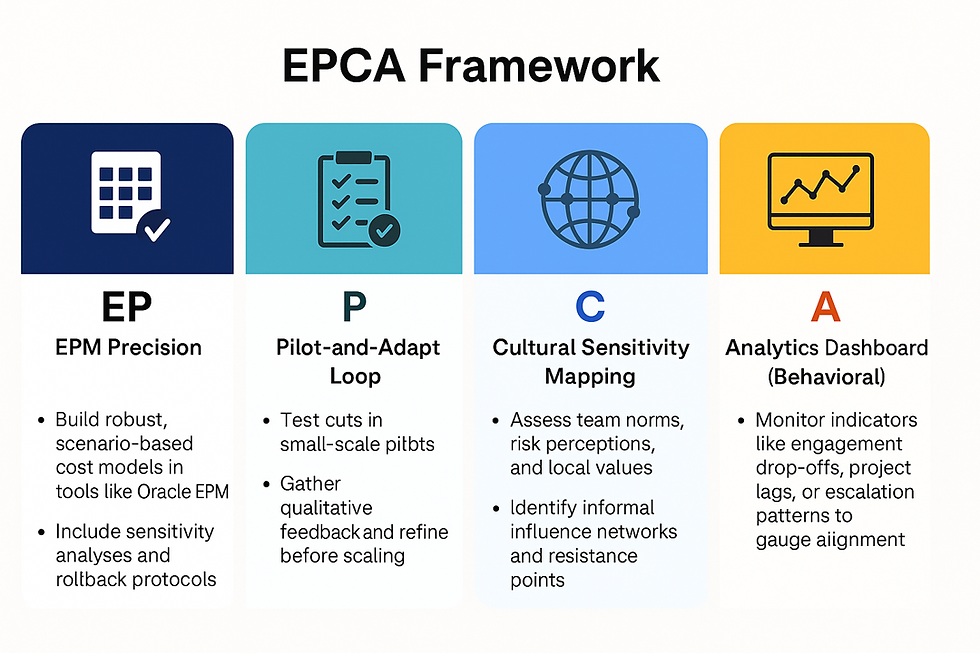
EPCA Framework
E – EPM Precision - Build robust, scenario-based cost models in tools like Oracle EPM. - Include sensitivity analyses and rollback protocols.
P – Pilot-and-Adapt Loop - Test cuts in small-scale pilots. - Gather qualitative feedback and refine before scaling.
C – Cultural Sensitivity Mapping - Assess team norms, risk perceptions, and local values. - Identify informal influence networks and resistance points.
A – Analytics Dashboard (Behavioral) - Monitor indicators like engagement drop-offs, project lags, or escalation patterns to gauge alignment.
Tools to Support
PwC Strategic Cost Intelligence Platform: Integrates financial and cultural data.
PwC Organizational Culture Alignment Service: Maps cultural dynamics to optimize change management.
🔵 Reflection
Are you mistaking silence for agreement? A CFO in Cebu lamented:
“Our numbers were bulletproof, but we missed the discomfort until it cost us.”
Listening between the lines is as critical as crunching the numbers.
6. Conclusion: The New Cost Leadership Mindset
Cost reduction is non-negotiable, but the approach must evolve. Complexity is as much cultural as operational. Future cost leaders will excel by pairing precise calculations with deep listening.
Controllers and CFOs must become curators of alignment, not just guardians of budgets. In an era of automation, trust remains the asset that never depreciates—and silence is never free.
7. References
Asher/PwC. Strategic Cost Intelligence Platform.
Coyne, K., et al. (2010). When You’ve Got to Cut Costs—Now. Harvard Business Review.
Livermore, D. (2025). Leading Global Teams Effectively. Harvard Business Review.
PwC (2024). CFO and Finance Leaders Pulse Survey.
PwC. Organizational Culture Alignment Service.


Comments